Sturmius Wehner Stiftung Zukunft

Sturmius Wehner Stiftung Zukunft
Sturmius Wehner Foundation Future
CHILDREN * EDUCATION * ENVIRONMENT
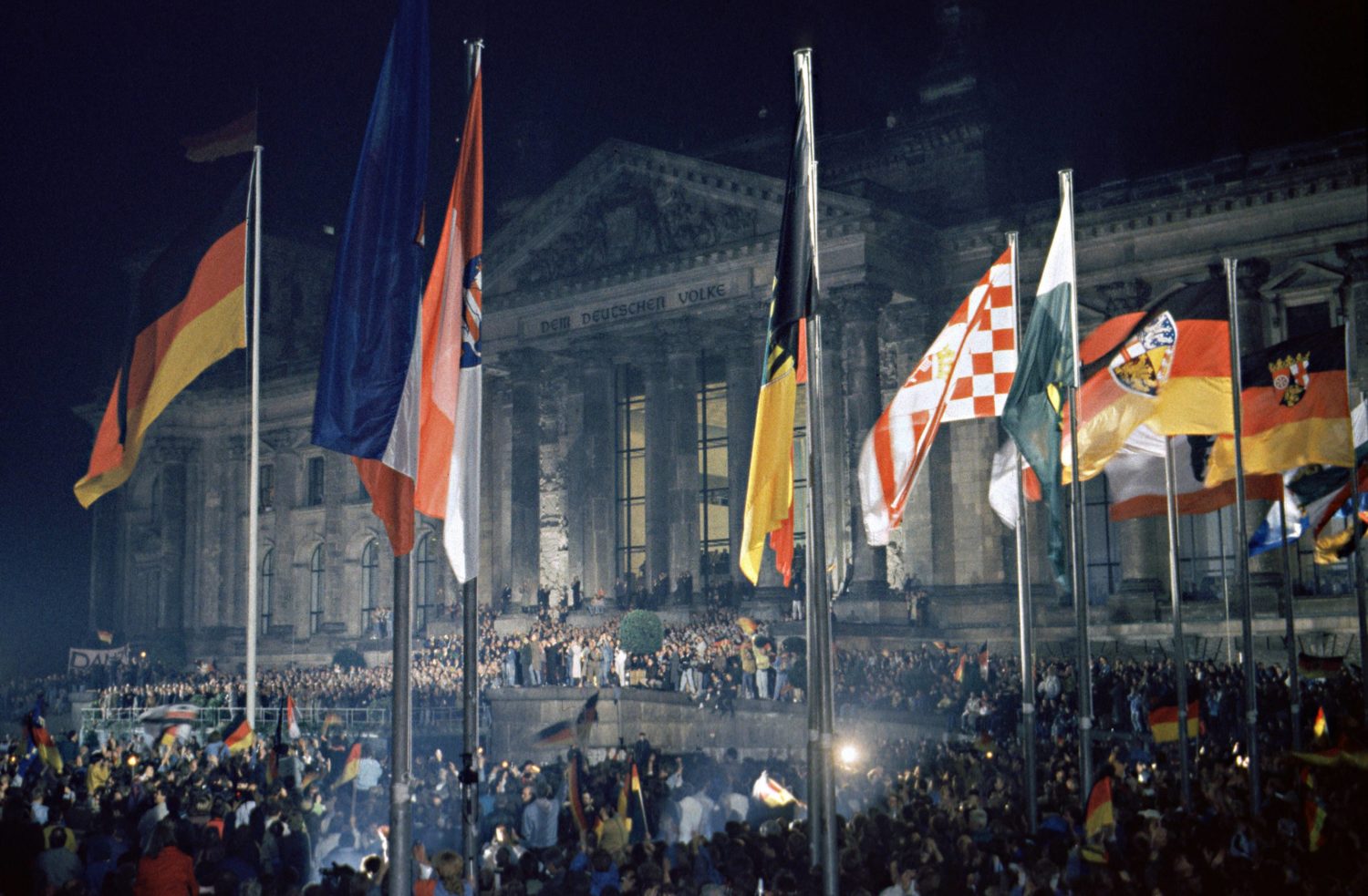
35 years ago today, Germany was reunified. Every year on this day, the significance of this event is commemorated, this year with a ceremony in Saarbrücken. It is worthwhile to raise awareness of this significance.
After the Second World War, defeated Germany was divided into four occupation zones by the victorious powers: the USA, France, Great Britain, and the former Soviet Union. The western zones developed toward democracy and a market economy, while the eastern Soviet zone developed toward a planned economy and socialism. In 1949, the Federal Republic of Germany emerged from the western occupation zones as a provisional state, with the demand for reunification in the preamble to the constitution and the Soviet occupation zone became the German Democratic Republic (GDR). Thus, there were two German states side by side. The former capital, Berlin, played a special role; like the country itself, it was divided among the victorious powers and split into West and East Berlin. In 1961, the division of Germany was cemented with the construction of a wall through the center of Berlin. The Berlin Wall symbolized not only the division of Germany, but also the global Cold War, in which Western democracies and Eastern dictatorships faced each other and continue to face each other today.
The two states developed very differently. In the Federal Republic, an unexpected economic boom occurred, partly thanks to US support as a result of the so-called Marshall Plan. People lived in democracy and freedom. Socialism prevailed in the GDR; production capital became public property; private property was possible, but strictly regulated. Production followed the plan, not demand. As a result, the GDR increasingly fell behind the Federal Republic economically. People didn't suffer from hunger and had jobs. But they lacked one thing: freedom. Emigration to the West was only possible for select individuals. For the general population, a trip from Eisenach to Frankfurt am Main was out of the question; they were imprisoned. Citizens were monitored; the so-called State Security, supported by informers, created a climate in which people became cautious and considered what they said to whom. The border between the two states was secured by soldiers who could and were encouraged to shoot anyone attempting to cross the border.
This situation had been established for over 30 years, and not many considered a united Germany realistic. But the people's pent-up longing for freedom began to erupt. This led to the emergence of the so-called Peaceful Revolution. The Monday demonstrations in Leipzig uttered the famous slogan "We are the people." Refugee movements increased. At the same time, the GDR government came under increasing pressure due to financial problems and isolation within the eastern states as a result of Russian President Gorbachov's liberalization policy.
On September 11, 1989, Hungary opened its border to GDR refugees. Throughout September, thousands of refugees gathered at the West German embassy in Prague. On September 30, then-German Foreign Minister Genscher and Chancellor's Office Minister Seiters arrived in Prague after negotiations in New York, Moscow, and with the GDR Foreign Ministry. When Genscher and Seiters appeared on the embassy balcony to shouts of "Freedom, freedom!" and Genscher said, "We have come to you to tell you that your departure...", the rest of his sentence was drowned out by deafening cheers. On November 9, 1989, the Berlin Wall finally fell. The images of countless overjoyed people driving through the Brandenburg Gate in their Trabants remain unforgettable. The GDR had effectively collapsed.
The rest was international law. In the GDR, the leadership and legislature had to find their feet again, and treaty negotiations for reunification were prepared. In addition, however, the victorious Allied powers also had to be involved. The so-called 2+4 negotiations began, spearheaded by then-Chancellor Helmut Kohl. The wording of the Unification Treaty was negotiated by then-Federal Minister of the Interior Wolfgang Schäuble and Parliamentary State Secretary Günther Krause as representatives of the GDR. After the treaty was passed in the parliaments and state assemblies with the necessary two-thirds majorities, the GDR's accession to the Federal Republic of Germany was possible, effective October 3, 1990.
What hardly anyone would have thought possible in 1988 had become reality in just over a year and a half. And it was achieved without violence. And it wasn't achieved through hatred either.
Legally, reunification took place on October 3, 1990. In fact, it is a process that continues to this day. Then-Chancellor Kohl promised "flourishing landscapes in three to four years," but in doing so, he was subject to an illusion. The harsh adjustment of socialist economic structures to the realities of the free market economy has resulted in numerous bankruptcies, job losses, and a loss of wealth. Lower productivity in East Germany has been reflected in lower wages and salaries. The expansion of economically strong West German companies into the East has enabled economic growth there, but has left power concentrated in the West. The differences in wages, salaries, and pensions have diminished, but are still present. The feeling of being second-class Germans remains strong, fueled by populist forces, and is now causing the country to drift apart again.
On the other hand, when it comes to the question of whether "it was worth it," it's actually appropriate to compare not only here and there, but also before and after. The shouts of "Freedom, freedom" in the Prague embassy called for something that is now reality. The journey from Eisenach to Frankfurt am Main is no longer a problem. And what you say to whom no longer requires careful consideration, even in eastern Germany.
The question, therefore, is what to focus on. Even more so when what is reality today—freedom and democracy—is anything but granted for free. This doesn't just apply to Germany—it applies worldwide. Democracies can be fought for—as was the case peacefully in East Germany. But if they aren't looked after, they can also relapse into dictatorships. We've seen this for 25 years in Russia and since this year in the USA. Propaganda, hatred, and violence are paving the way.
The path to reunification was worthwhile - like every path - as long as we remember what we have achieved, remember that it cannot be taken for granted, and ensure that it is not lost again.