Sturmius Wehner Stiftung Zukunft


Sturmius Wehner Stiftung Zukunft
Sturmius Wehner Foundation Future
CHILDREN * EDUCATION * ENVIRONMENT
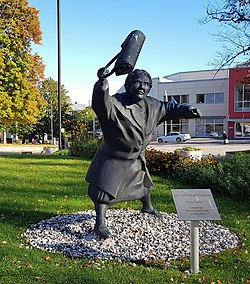
In 1985, forty years ago, Hans Runesson's picture was the photo of the year in Sweden. A woman hits a neo-Nazi with her handbag. The woman was Danuta Danielsson, née Sen, who was born in Poland to Jewish parents and whose mother had survived a concentration camp. The blow occurred at a demonstration organized by the right-wing radical Nordiska Rikspartiet (Northern Socialist Party).
Thirty years later, the Swedish sculptor Susanna Arwin wanted to erect a monument to commemorate Danielsson's courageous stand against the neo-Nazi demonstration. However, this was never approved because the monument was deemed to glorify violence. In protest against this decision, many Swedish statues were decorated with handbags.
One can laugh at the anecdote because of the simplicity of the "weapon," one can admire the woman's courage, one can view the discussion about its potential glorification of violence with ambivalence, and one can recognize the subsequent nationwide decoration of statues with handbags as a form of resistance in a sophisticated way. In any case, the importance of resistance is made clear in many ways.
After a good hundred days of the Christian Democratic Union (CDU)-Social Democratic Party (SPD) government, widespread disillusionment has set in. Poll ratings for the so-called democratic center are plummeting, and a party widely considered right-wing extremist has become the strongest political force in the same polls.
This cannot necessarily be attributed to the government's exclusively dismal record. In terms of foreign policy, much has been achieved that either failed to make it into the focus of public debate or was unable to remain there. Germany once again has a voice in global politics. After years with a pale Chancellor, during which Germany was no longer taken seriously in Europe and the world, the new incumbent has got the Franco-German engine running again, reactivated the Weimar format, including Poland, and even successfully managed his inaugural visit in the White House. Germany is the driving force in the so-called Coalition of the Willing against the still-raging brutal war of aggression against Ukraine. Considering that foreign policy issues such as combating this war of aggression are certainly relevant to very concrete domestic issues such as migration or energy prices, it should be recognized that this is quite an achievement. Above all, however, it is a form of resistance that cannot be valued highly enough in view of the dramatically changed geopolitical situation.
Another target of resistance was to be the continued strengthening of the right-wing AfD. The result of the federal election was a wake-up call. Strong warnings were issued that this legislative period was "the last bullet" and that the democratic center must stick together to push back the anti-democratic forces. Indeed, the relaxation of the debt brake and the special funds for defense, infrastructure, and climate protection were not the only impressive results of this cohesion. However, this common understanding continually eroded when it came to day-to-day politics and concrete issues such as the budget, migration, citizen's income, minimum wage, taxes, energy, etc., sometimes over problems that would make a civilian in an air raid shelter in Kyiv shake his head. These advances met with massive resistance not only from the population but also from the coalition partner. The quarreling government was a déjà vu, and the democratic center turned itself into a cliché. The resistance against the anti-democratic forces fell victim to resistance against the partner. The AfD is now the strongest force in the polls.
The global and largely functioning balance between Western liberal democracies and Eastern dictatorships functioned with the United States as it’s fundamental force, offering resistance to imperial ambitions or being able to deter them. Europe, too, has recklessly relied on America. With a president who admires dictators, considers them his friends, but is in no way a match for them in terms of negotiating skills and doesn't even recognize this, resistance to dictatorships is significantly weakened, and these dictatorships are mercilessly exploiting this. The russian president is dropping a bite of propaganda like “next meeting with Trump possible in the near future” to the western world from time to time and can then unhindered continue bombing. The hybrid war now extends far beyond Ukraine. The largely toothless rest of the Western world is paying for decades of naivety and carelessness.
In the USA itself, the president is systematically transforming the world's oldest democracy into a dictatorship. Deportations of innocents, disregard of laws and court rulings, circumvention of Congress, illegal occupation of democratic states by the National Guard, torpedoing of the independence of the Federal Reserve, coordination of the media and universities, etc., etc., a serious constitutional crisis.
Is there resistance? The Republicans in Congress, who have sworn an oath to this Constitution, remain silent. The Democratic opposition, whose members have sworn an oath to the Constitution, is largely silent. The military, who have sworn an oath to the Constitution, obey. The courts set limits, but on the one hand, they can barely keep up and, on the other, they have no executive power to enforce their rulings. "Flood the zone with shit" is working. Of the 19 Democratically governed states, only the governors of Illinois and California are opposing the president. Only sporadically are the people taking to the streets. Most universities and businesses are bowing to the pressure placed on them.
Social media, however, is teeming with critical posts, comments, videos, and memes. Gavin Newsom, Governor of California, has now become the loudest voice of resistance, and he's doing so not only with arguments, but also with a campaign of images and memes in which he imitates and caricatures the president's communications (personal attacks, loud capital letters, boundless self-praise) and mocks the president with self-heroic images. This campaign may seem tacky, but it's proving surprisingly effective. Above all, it's getting noticed and seems to be the first effective antidote to "flood the zone with shit."
To the observer, this campaign looks similar to the 1985 strike by Danuta Danielsson in Sweden: not elegant, not refined, not diplomatic, rather primitive. But resistance is sometimes not only important, it must also be effective... if needed with a handbag.