Sturmius Wehner Stiftung Zukunft
Sturmius Wehner Stiftung Zukunft
Sturmius Wehner Foundation Future
CHILDREN * EDUCATION * ENVIRONMENT
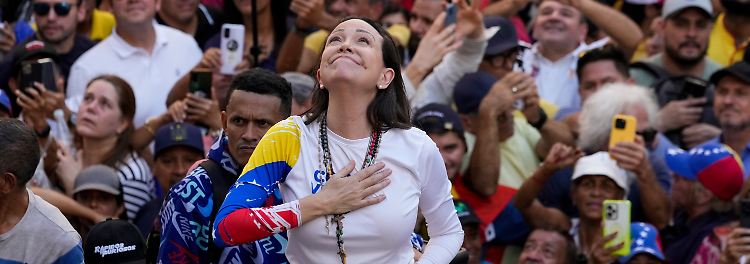
Today at 11:00 a.m. in Oslo, the Nobel Committee announced that this year's Nobel Peace Prize goes to Venezuelan opposition leader Maria Corina Machado. She is being honored for her "tireless commitment to the democratic rights of the Venezuelan people and for her struggle for a just and peaceful transition from dictatorship to democracy."
Venezuela has been characterized by authoritarianism since the reign of Hugo Chávez, which began in 1998. Current President Nicolas Maduro has continued this course since 2013. The country boasts the world's largest oil reserves – followed by Saudi Arabia. But since the 1980s, it has descended into a deep economic and humanitarian crisis as a result of falling oil prices, mismanagement, and the global economic crisis. Between 2014 and 2020, the country lost approximately 80% of its gross domestic product. Over 80% of the population is considered poor. Seven million Venezuelans - a quarter of the population - have left the country in the past 11 years. Maduro was last re-elected in 2024 after fraudulent election results were announced.
Maria Corina Machado, daughter of an industrial family, is considered a staunch opponent of President Maduro and is described by the Nobel Committee as "a leader of the democracy movement in Venezuela..., ...one of the most extraordinary examples of civic courage in Latin America in recent times... and ...a key figure in a once deeply divided opposition." She has repeatedly been subjected to repression and intimidation, accused of treason, and survived an assassination attempt in 2011. Today, she lives in hiding to avoid arrest and usually makes surprise appearances. In 2024, she was a promising opposition candidate in the presidential elections, but was subsequently barred from the election.
On the surface, democracy has nothing to do with peace. One is a form of government in which, according to the literal meaning of the word, the people are the rulers. The other is a state without war or violence. However, it is a modern phenomenon that the two correlate, or are mutually dependent resp. This is because people generally do not want war. Dictators are more inclined to it. To the extent that democracy is threatened, the danger of war increases.
Democracy is under pressure worldwide, especially in its homeland, the West. America, and in Europe, especially Hungary, but followed by France and now Germany. Therefore, this year's award should also be understood as a signal to this effect and a warning that should be heard.
Democracy cannot be taken for granted. This is easily forgotten when people live within it. And this leads to inertia and blindness – an inertia and blindness that made Hitler's seizure of power in 1933 possible, an inertia and blindness that currently plays into the hands of an overreaching president in the USA, and an inertia and blindness that gives considerable room to Russia's current war of aggression in Ukraine and its hybrid war against all of Europe.
Resistance requires overcoming this inertia and blindness. There is a merciless law: the more democracy is weakened or even dissolved, the more difficult and dangerous this resistance becomes. In Russia, people like Alexei Navalny paid for this with their lives.
Venezuela was also a democracy after the overthrow of dictator Jimenez in 1958. However, in the 1980s and 1990s, as a result of economic decline due to falling oil prices, corruption, and mismanagement, which in turn led to uprisings that were crushed, Venezuela increasingly developed into a military regime before becoming a dictatorship under Chavez's presidency.
Maria Corina Machado represents this resistance, which is necessary for the path (back) to democracy. She would certainly have had it easier in the 1980s. The Nobel Committee today recognized and emphasized this resistance. This can also be seen as a signal and a warning in this regard.
Perhaps never before has today's announcement been as eagerly awaited as this year. And perhaps never before has the question of who didn't receive the prize been almost as important as who did. This is thanks to US President Trump, who, contrary to usual practice, claimed the prize for himself, supported by his apparatus and political friends like the Israeli Prime Minister, justifying it with the alleged ending of—depending on the version—seven, eight, or ten wars, and accompanied by indirect and direct pressure on the committee.
One could call this the lack of realism or the audacity of a man who has been undermining democracy for months, transforming it into a dictatorship, deploying the National Guard in democratically governed cities to take action against innocent citizens, and turning the judiciary into an accomplice in the persecution of his opponents. But it is encouraging that the committee is among those who have not bowed to his abuses. That, too, is resistance.